



The putting stroke path is the direction your putter head travels through impact relative to the target line. Getting that path consistently on track is one of the fastest ways to hole more putts.
What exactly is putting stroke path?
Putting stroke path is the direction the putter head moves through the impact zone, described relative to the target line. If the head travels directly along the target line at the moment it strikes the ball, the path is neutral. If it moves from outside to inside — across the ball — the path is out-to-in. If it moves from inside to outside, the path is in-to-out.
Path is one of two variables that determine where a putt starts. The other is putter face angle. Research on ball-flight laws confirms that face angle accounts for roughly 75 to 80 percent of the initial direction, with path making up the rest. That means path is not everything, but ignoring it leaves a meaningful piece of accuracy on the table.
How does path differ from face angle?
Face angle is where the putter face points at impact; path is the direction the head is moving. The two are related but independent, and understanding the difference saves a lot of confused practice time.
Think of it this way. You can have a square face and still pull the putt if your path goes hard left through the hitting zone. Conversely, a slightly open face can be compensated by an in-to-out path, producing a relatively straight roll. Problems multiply when path and face work against each other in unpredictable combinations. That is why coaches typically want to stabilize path first, then address face angle. A consistent path makes the face angle error repeatable and therefore easier to correct.
| Path direction | Typical ball behavior (right-handed golfer) |
|---|---|
| Straight through (neutral) | Ball starts on intended line |
| Out-to-in (across) | Pull left of target |
| In-to-out | Push right of target |
| Inconsistent | Scatter pattern, no predictable miss |
Should your stroke path be straight or arcing?
Neither is universally correct, and this is where a lot of instruction creates more confusion than it resolves. A straight-back-straight-through path works well for golfers who set up with the ball directly under their eyes and use a more upright putter. A gentle arc — inside on the backswing, square at impact, back inside on the follow-through — suits a slightly more tilted address position and a lie angle that reflects that tilt.
The important word is consistent. What breaks putting down is not the shape of the arc but the variation from stroke to stroke. A golfer who arcs differently on a four-footer than on a twenty-footer has a path problem. One whose arc is the same every time has a reliable stroke, whatever its shape. When choosing golf training aids to work on path, look for tools that match the stroke style you are actually trying to build, not someone else's ideal model.
What causes a faulty path and how do you detect it?
The most common cause is upper-body rotation through impact. When the shoulders open toward the target too early, the putter head moves left across the ball. This produces the classic pulled putt that golfers often misread as a misread green.
A secondary cause is grip tension. Tight hands restrict the natural swing of the putter and force compensation through the arms. The path becomes erratic rather than consistently wrong in one direction, making it harder to diagnose without feedback.
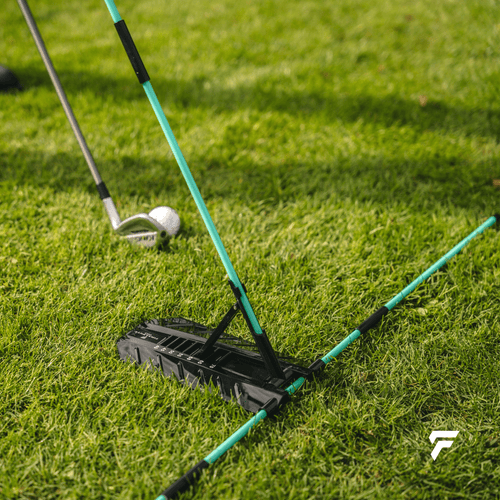
Detection is straightforward with the right setup. Place two alignment sticks or club shafts on the ground just wider than the putter head, forming a channel along the target line. Hit putts and watch whether the head clips either side. Clipping the outside rod early in the backstroke suggests you are taking the putter too far outside. Clipping the inside rod through impact points to an out-to-in path problem. This kind of immediate feedback is exactly what structured putting practice is built around.
When is path not the main problem to fix?
If your putts start on the right line but consistently drift off over longer distances, path is probably fine and green-reading or stroke tempo is the culprit. Path primarily influences the first foot or two of ball direction. Beyond that, green slope, grain, and speed take over.
Path drills are also not the right starting point if your setup fundamentals are missing. Ball position, eye line, and stance width all affect path. Fixing those first sometimes resolves an apparent path issue without any specific path drill at all. If you are unsure where to start, a short session with a teaching professional before investing in equipment gives you a clearer target.
Frequently asked questions
Can I have a good putting stroke path and still miss putts consistently?
Yes. A correct path only controls the starting direction of the ball. If your face angle is open or closed at impact, or if your green reading is off, the putt will still miss. Path is one piece of a system that also includes face control, tempo, and speed judgment.
Does putting stroke path matter the same on short putts as on long putts?
Path has a greater visible effect on short putts because any directional error shows up clearly against a small target. On longer putts, path errors can be masked by green imperfections or be less obvious, but they still determine where the ball starts and how much margin you have left for the comeback putt.
How long does it take to improve putting stroke path with deliberate practice?
Many golfers see measurable improvement in path consistency within two to three practice sessions when they use a tool that provides immediate feedback. Ingraining the change under pressure on the course typically takes several weeks of reinforcement, because motor patterns built under low stress do not always hold when a putt matters.
Is putting stroke path different for left-handed golfers?
The mechanics are a mirror image, but the principles are identical. An out-to-in path for a left-handed golfer pushes the ball to the right of target, the opposite of a right-handed miss. All path drills and training tools that are designed for both orientations apply equally well regardless of which hand leads the stroke.
You may also like
Read more
 What Is Swing Plane in Golf?What's the best training aid to fix my swing plane?
 How to Use The Rotation TrainerHow Wide Should Your Golf Stance Be?Find out exactly how wide your golf stance should be for every club — and why getting this fundamental right improves…What's the best putting aid for improving speed control on the greens?What's the best putting training aid to improve my accuracy on the green?
 How to Use The Swing HingeWhat putting aid will help me improve my stroke consistency?